It’s been exactly one week since the Super Bowl LIX happened and it is still on my mind. The halftime show. Let’s be real, if you aren’t a fan of the teams playing or not a football fan in general then you are only watching the super bowl for two things: the halftime show and the commercials. This year the halftime show was undeniably the star, if you aren’t a football fan.
There’s no arguing Kendrick Lamar’s talent in storytelling in his music and performances. Regarding the Super Bowl, it was difficult not to question what would happen. Is he going to perform “Not Like Us”? What is his opening song going to be? Will he bring out other surprise guests?
No one could have predicted the artistic and politically charged performance Kendrick Lamar delivered. It sparked everything from creating viral fashion trends to increased streams of his music to political conversations.
From the very beginning, the show demanded attention. Opening with legendary actor Samuel L. Jackson dressed as Uncle Sam was an unexpected but powerful choice. At first, I wasn’t sure if the entire performance would be a commentary on America, but as it unfolded, it became clear that Kendrick was making a statement.
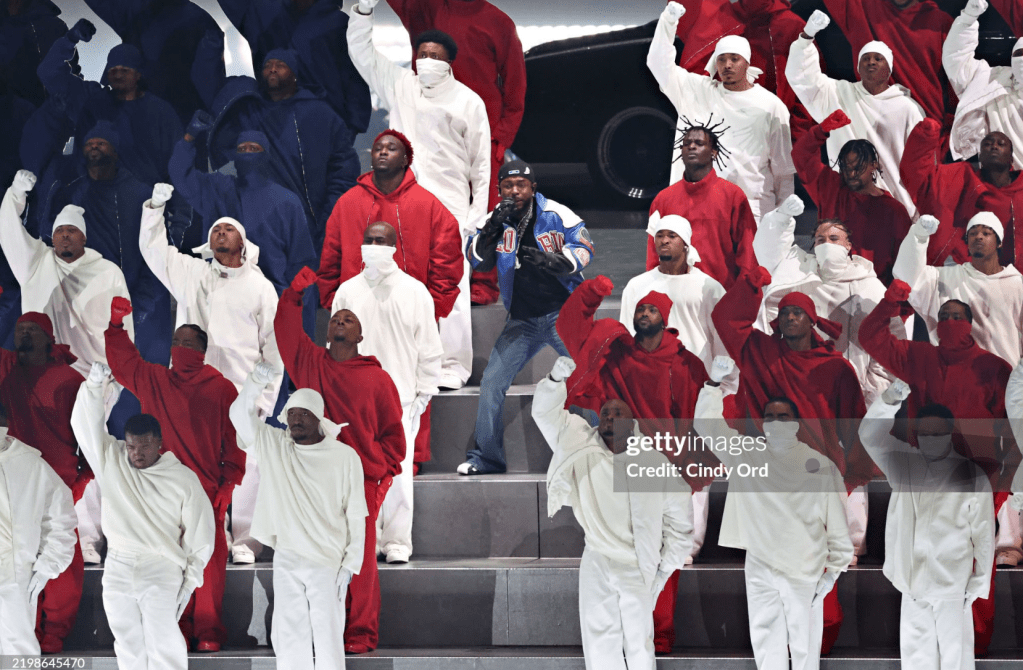
The production design was striking. A stage that was laid out like a PlayStation controller with each space shaped like the buttons. Symbolizing Lamar’s life similar to a video game, one that is full of choices, challenges, and levels to beat. This theme extended beyond the stage.
As the performance continued, the lights in the crowd displayed “Warning Wrong Way” while Lamar performed in a prison yard, reinforcing the idea of navigating a system designed with difficult challenges and consequences. Very similar to a video game, every move has repercussions, and the wrong path can lead to failure.
Then, the lights flashed “Game Over.” This signaled not just the end of the show, but possibly initiated the conclusion of the ongoing feud with Drake or relating to the broad message about societal struggles. The entire production told a deeper story of choices, consequences, and the challenges of navigating realities in America.
The anticipation surrounding “Not Like Us” was undeniable. We eagerly awaited the moment. Lamar teased the song throughout the performance. Once he sang it, he didn’t hold back. Throughout the performance, Lamar made sure to make digs at Drake. Having a devious smile while performing “Not Like Us” was clearly directed toward Drake, but he didn’t stop there. Lamar made sure to have two of Drake’s exes in the performance. Yes, that is right two. Both SZA and Serena Williams performed their own role. SZA sang in her featured songs and Williams made a surprise appearance during “Not Like Us” where she was crip walking to pay homage to Lamar and her hometown, Compton, and an intentional dig at Drake.
Lamar’s fashion choices were also packed with meaning. His jacket had “Gloria” written on the front, referring to his “GNX” album. His lowercase “a” chain sparked theories that it referenced the “A-minor” line in “Not Like Us,” or that it is connected to the logo of his company pgLang.
Although those choices had meaning, his jeans ironically circulated a wide spread of content online instead. Social media was consumed with memes, fans and even Jimmy Fallon creating his outfit, and brands releasing content about the specific jeans he wore.
Beyond the music, the performance was a cultural phenomenon. Lamar standing in the middle of the American flag, with each side’s backs turned against one another, wasn’t a patriotic gesture—it was a visual representation of a country divided by racial and political tension. As well as Samuel L. Jackson’s portrayal of Uncle Sam added another layer of meaning. It symbolizes a disapproving gaze at the state of America and its direction.
Looking back at every detail of the production design, the symbolism woven in the performance, the political undertones, and the subtle yet deliberate jabs at Drake, it’s clear that this halftime show was more than just entertainment. Lamar didn’t just put on a show. He created a cultural moment that introduced conversations about race, politics, and the power of artistic expression.
The fact that people are still analyzing and discussing its deeper meanings proves its lasting impact. A performance like this doesn’t just fade away—it lingers, challenges perspectives, and demands attention long after the final note. That’s the power of Kendrick Lamar.
Didn’t watch the performance? Watch it here: https://www.youtube.com/watch?v=KDorKy-13ak
Read more about the symbolism of the performance here: https://www.theroot.com/the-complete-breakdown-of-the-symbolism-references-in-1851760266
 Natalie Thomas
Leave a comment